
CCNA 200-301 retired - next move on the new Cisco cert path
> *"Cisco retired CCNA 200-301 last month. People who already hold it are asking what it becomes. People who were studying for it are asking what they should study instead. The honest answer is that neither cohort needs to panic, but the cohort with study materials still in the bag should pivot this week, not next quarter."* Last Wednesday I got a message from a former colleague who passed his CCNA 200-301 two years ago. He is up for a promotion in October that requires an active Cisco certification on file. His question was short: "Is my CCNA still worth anything?" I told him yes, with a caveat I had to check before I could be sure. His cert is grandfathered. Cisco does not revoke certs just because the exam version changes. But Cisco also flagged in late June that they would review the renewal credit requirements for grandfathered CCNA holders by Q1 2027. That matters because the renewal path he planned to use may not exist in the same form next year. Meanwhile, a separate group of people bought CCNA 200-301 study materials, worked through half the labs, and never sat the exam. Cisco retiring the exam on 25 June means those study materials now point at a test that no longer exists. That group has a different problem and a different timeline. I spent the past week working through the Cisco Learning Network announcements from 23 July, the new credit-allocation table, and the community threads from people in both cohorts. Here is the path forward, broken down by which cohort you fall into.
TL;DR
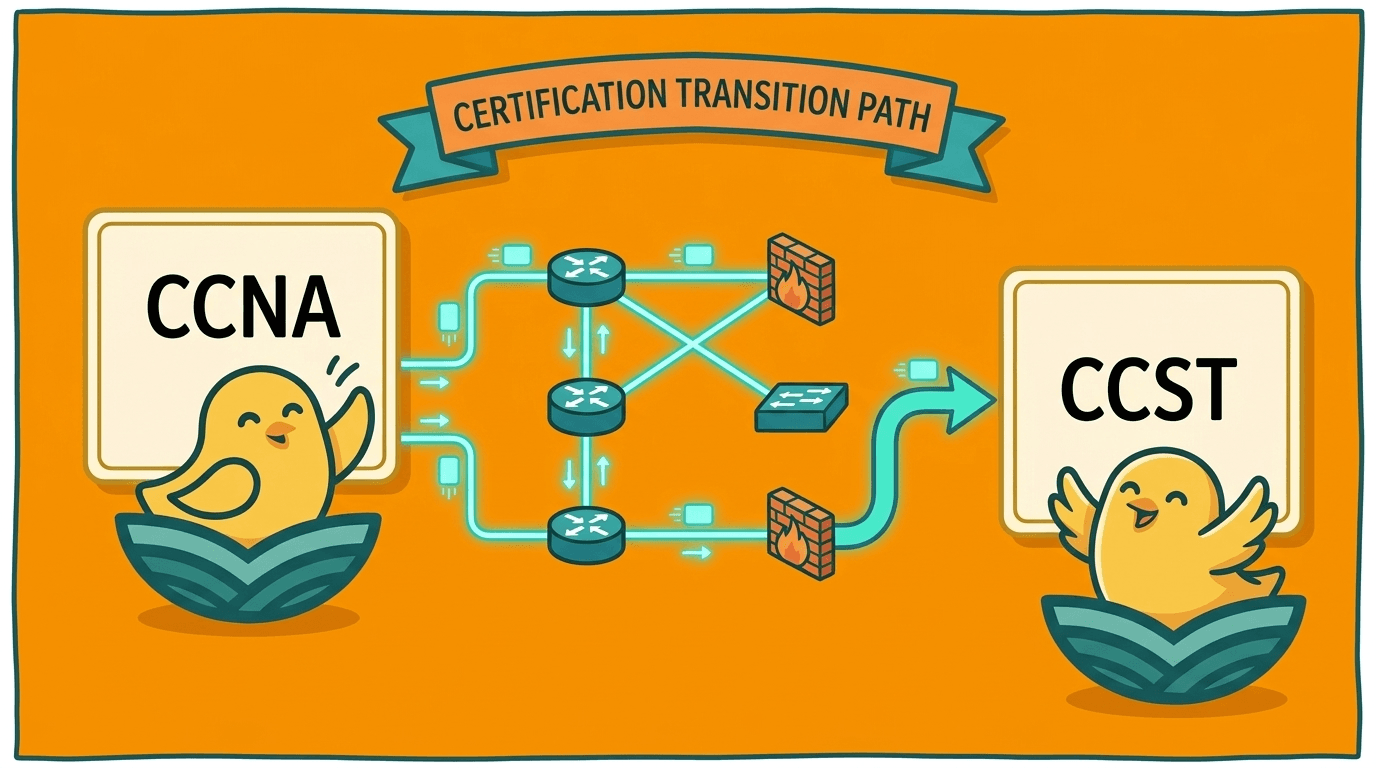
Cisco retired CCNA 200-301 on 25 June 2026. The replacement entry-level certification is now the CCST (Cisco Certified Support Technician) track. If you already hold CCNA 200-301, your cert is grandfathered but review is coming in Q1 2027. If you were studying for 200-301 but never sat, you need to pivot to the CCST track this month. Either way, the new path is three exams instead of one, and the credit-transfer table Cisco published last week gives you a map.
- If you hold a current CCNA 200-301: your cert is valid until its normal expiry. Watch for Q1 2027 renewal rule changes. - If you were studying for 200-301 but did not sit: pivot to CCST Routing & Switching now. Your study time is not wasted. - If you are starting fresh on the Cisco path: start with CCST, not a retired exam.
What you need to do: identify your cohort below, check the credit-transfer table, and plan your next certification step before September.
By The Numbers: the CCNA 200-301 retirement
| Metric | Detail | |--------|--------| | Retirement date | 25 June 2026 | | Cohorts affected | 2 (existing holders + active studiers) | | New entry-level certification | CCST (Cisco Certified Support Technician) | | Exams on the new track (to CCNP level) | 3 (up from 1) | | Grandfathered cert review window | Q1 2027 | | Credit-allocation table published | 23 July 2026 on Cisco Learning Network |
What actually happened
Cisco formally retired the CCNA 200-301 exam on 25 June 2026. This is standard lifecycle for Cisco certifications. The CCNA 200-301 had been the entry-level networking certification since February 2020, replacing the earlier 200-125 and 100-105 exams. Six years is a long run for a Cisco exam version, and the retirement was not a surprise to anyone tracking the certification roadmap.
What did surprise people was the replacement. Instead of a new CCNA exam version (the pattern everyone expected, like 200-302 or a similar iterative update), Cisco introduced the CCST track as the new entry-level certification. CCST stands for Cisco Certified Support Technician, and it is structured differently from the CCNA it replaces.
The new path is:
- CCST Routing & Switching (entry-level, one exam)
- CCNP-level equivalent (mid-level, one exam that maps to what CCNA used to cover)
- Specialist (advanced, one exam)
That is three exams to reach roughly the same level of certification that CCNA 200-301 used to cover in one exam. Cisco's argument is that the new path offers more granular specialisation and better alignment with real job roles. Whether that argument holds depends on whether employers recognise CCST the way they recognised CCNA.
Cohort 1: You already hold a current CCNA 200-301
If you passed CCNA 200-301 and your certification is still active, you are grandfathered. Cisco does not expire a certification just because the exam version changes. Your CCNA remains valid until its normal expiry date, which is three years from the date you passed.
The catch is that Cisco announced alongside the retirement that they would review the renewal credit requirements for grandfathered CCNA holders by Q1 2027. That sentence is doing a lot of work. It does not say your cert will be harder to renew. It says they are reviewing whether the current renewal path still makes sense given that the original exam no longer exists.
Right now, CCNA renewal works the same way it always has: earn 30 continuing education credits, or pass any professional-level or specialist exam, or retake the current CCNA exam. Since CCNA 200-301 no longer exists, the retake option is gone. The CE credit path and the professional-exam path are still available, but the Q1 2027 review may change the CE credit requirements or introduce new renewal conditions.
If you hold a current CCNA and your renewal is due before Q1 2027, you have nothing to worry about. Follow the existing renewal path and your cert stays active.
If your renewal is due after Q1 2027, you should watch the Cisco Learning Network for the review outcome. I would set a calendar reminder for January 2027 to check whether the renewal rules have changed.
Cohort 2: You bought study materials for 200-301 but never sat
This is the cohort with the harder timeline. You bought the Cisco Press guide, worked through the labs, maybe paid for a practice exam subscription. Then Cisco retired the exam before you sat it.
The good news: your study time is not wasted. The core routing and switching concepts that CCNA 200-301 covered (VLANs, STP, OSPF, EIGRP, basic security, automation fundamentals) carry forward into the new CCST Routing & Switching exam. Cisco designed the CCST track to cover the same conceptual territory, not a completely different body of knowledge.
The bad news: the exam format is different. CCST uses a different question style, a different lab format, and a different passing score. Your CCNA 200-301 practice exams will not be representative of what you will see. And the CCST track requires three exams to reach the level that CCNA used to cover in one, so your total certification cost is higher than you budgeted.
What I would do this week: check whether your CCNA study materials are still returnable or transferable. Some providers (Cisco Press, INE, and others) offered refunds or exchanges after the retirement announcement. Then check the CCST Routing & Switching exam blueprint on the Cisco Learning Network and decide whether you want to pivot to CCST or switch to a competing certification like CompTIA Network+ or Juniper JNCIA-Junos.
If you pivot to CCST, your existing CCNA study time gives you a head start of roughly 40-50 percent on the routing and switching fundamentals. You are not starting from zero.
The credit-transfer table Cisco published on 23 July
On 23 July the Cisco Learning Network published the official credit-allocation table for the new track. This table tells you which existing certifications earn you credit toward the new path. The important rows for most people:
| Your current cert | What it earns you on the new path | |-------------------|-----------------------------------| | CCNA 200-301 (active) | Full credit for the CCST Routing & Switching exam. You are already at CCST level. | | CCNA 200-301 (expired within 3 years) | Partial credit. You need to take CCST Routing & Switching but the exam may be shorter or discounted. Exact details vary by region. | | CCNP Enterprise (active) | Full credit for all CCST-level and CCNP-level exams. You are ahead of the new path. | | No Cisco cert, but CompTIA Network+ | No direct credit, but Network+ covers roughly 30 percent of the CCST Routing & Switching blueprint. |
The full table is on the Cisco Learning Network and covers additional scenarios (DevNet certs, older CCNA versions, specialist certs). If your exact situation is not listed here, the Learning Network page has the complete list.
Mid-article checkpoint: what this means for your study plan
If this is the first time you are hearing about the CCNA retirement and the CCST replacement, you are not behind. The retirement was 25 June, the credit table came out 23 July, and the CCST exams were already available at launch. You have a four-week window since the credit table was published to decide your path, and the CCST exams are not retiring any time soon, so there is no rush to sit before a deadline.
What you lose by waiting is time, not opportunity. Every month you delay is a month you are not holding an active Cisco cert, and for people in the middle of a job search or a promotion cycle, that can cost you.
If you are in Cohort 2 (study materials, no exam), the one thing I would not do is hold on to the old materials and hope Cisco releases a direct one-to-one replacement exam. They will not. The CCST track is the replacement, and it is three exams, not one. The sooner you pivot, the sooner you stop studying material that will never be on a test you will sit.
FAQ
Is my CCNA 200-301 worthless now?
No. If it is active, it remains valid until its normal expiry. If it expired, it no longer carries weight, but you can earn credit toward the new path based on your previous cert status (see the credit-transfer table above).
Should I sit the CCST exam or wait for a new CCNA version?
Cisco has not announced a new CCNA exam version. The CCST track is the entry-level path going forward. Waiting for a "CCNA 200-302" that may never come is not a strategy.
Can I take the CCST exams online or only at test centres?
Both. Pearson VUE offers CCST exams at test centres and through online proctoring, same as the old CCNA exams.
How does CCST compare to CompTIA Network+?
CCST is Cisco-specific and covers routing and switching from a Cisco configuration perspective. CompTIA Network+ is vendor-neutral and covers broader networking concepts without device-specific commands. They serve different purposes. If you work in a Cisco shop, CCST is the better choice. If you work in a mixed-vendor environment, Network+ plus CCST gives you both breadth and depth.
Does the CCST path cost more than CCNA 200-301 did?
Yes. CCNA 200-301 was one exam at USD 300. The CCST Routing & Switching exam is USD 125, but you need three exams to reach the same level, so the total is roughly USD 375 plus study materials for each exam. The per-exam cost is lower; the total cost is slightly higher.
Further Reading
- Cisco Learning Network - CCNA 200-301 retirement notice (25 Jun 2026, via Google News RSS)
- Cisco Learning Network - New CCST entry-level track and CCNP credit mapping (23 Jul 2026, via Google News RSS)
- r/networking - CCNA 200-301 aftermath discussion (24 Jul 2026, via DuckDuckGo HTML)
- ReadRoost market note - CCNA replacement path analysis (24 Jul 2026, internal)
- AWS Advanced Networking Specialty: take or wait? (ReadRoost, Jul 2026)
- AWS AI Practitioner vs Machine Learning Associate head-to-head (ReadRoost, Jul 2026)
- Cisco - CCST Routing and Switching exam blueprint
- CompTIA - Network+ certification
*Mathew Clark / Founder, SecureInSeconds / Currently: waiting for the first "is my CCNA still valid?" email from a friend who passed his exam the week before Cisco retired it*


Reading is good. Practising is better.
Practice questions, flashcards and timed exams for 57 certifications. Start with a free starter pack — no card needed.